The Perfect Payoff of The ‘Avatar: The Last Airbender’ Finale
This essay is part of our series Episodes, a bi-weekly column in which senior contributor Valerie Ettenhofer digs into the singular chapters of television that make the medium great. This entry looks at the brilliant series finale of Avatar: The Last Airbender.
Payoff: it’s something pop culture lovers often take for granted. Every Hero’s Journey needs a fulfilling ending. One that supports its central ethos, brings its character-building to a natural stopping point, and carefully ties a bow on a story that ultimately feels like a gift. Peter Jackson’s The Lord of the Rings trilogy offers a classic example of great payoff. More recent attempts, like the end of Game of Thrones and The Rise of Skywalker? Not so much.
For storytellers, the pressure of nailing an ending is already a heavy burden. Still, when telling an epic story to a passionate audience, the stakes can, at times, become outlandishly high. Luckily, when writers look for the gold standard of endings, there’s already a fantastic model to reference–one that, until recently, flew under the radar: Avatar: The Last Airbender.
A generational favorite when it originally aired on Nickelodeon, Avatar: The Last Airbender has recently found widespread attention on Netflix. There’s one thing longtime fans and new viewers alike can agree on, though: the series’ cinematic, feature-length series finale is a huge, delicious slice of payoff with a (pit-free) cherry on top.
When we think of “Sozin’s Comet,” it’s impossible to call just one moment to mind. The four-part finale is split almost entirely between moments of memorable dialogue in its first half, and indelible, action-based imagery in its second. There’s the mad queen Azula (Grey Griffin), cutting her hair into jagged bangs on coronation day while a hallucination of her mother taunts her with compassion. There’s scorned, humbled prince Zuko (Dante Basco) tearfully reuniting with the series’ true heart, his Uncle Iroh (Greg Baldwin). There’s Sokka (Jack DeSena), Suki (Jennie Kwan), and Toph (Michaela Jill Murphy) working together to take down a massive fleet of Fire Nation airships. The fan-favorite mentor characters in The Order of the White Lotus work to reclaim the Earth Kingdom capital city, Ba Sing Se. And, of course, there’s our Avatar Aang (Zach Tyler) facing down the Fire Lord Ozai (Mark Hamill) once and for all against a red-soaked, barren landscape.
A particularly breath-taking sequence involves a fire-fight between Zuko and Azula, two angry kids whose despot father made them hard and wanting in different ways. The scene is wordless, with a deliberate, mythic score; this episode, unlike others, was accompanied by a live orchestra, and the result is some of the most beautiful scoring ever brought to life on a children’s series.
It’s one of a half-dozen moments in the finale that’s capable of bringing tears to one’s eyes, especially on the first watch-through. Zuko’s long road to redemption is by far the series’ best-written arc, one that appears to have inspired several other characters in pop culture since (cough, Ben Solo, and She-Ra’s Catra). That Zuko more-or-less loses to Azula, only to be rescued by Katara at the last minute, is beside the point; for the first time, he knows who he is and what he wants to fight for, and when he falls, he’s willing to seek help getting back up again.
As the final chapter of a series that focuses earnestly on wisdom and betterment, it only fits that our heroes display every one of their rare and hard-earned skills in “Sozin’s Comet.” Toph’s metal-bending, Katara’s healing, Zuko’s control of lightning, Sokka’s mechanical ingenuity, and Aang’s pure-heartedness are all essential to restoring peace to the world. We’ve seen the group build these skills across three seasons. In this mythology-based universe inspired by Eastern religion and tradition, physical actions are anchored to traits like patience, perseverance, and self-control. Those lessons are just as hard-won, and it’s a reward to see the group, toughened but never made cynical by their experiences, carry them together through the battlefield.
Avatar: The Last Airbender has always asked questions that are much bigger than our cultural expectations for a children’s series. In its more introspective moments, “Sozin’s Comet” returns to one of the series’ toughest ones: how can pure hope–in this case, in the form of Aang, a peaceful monk–persist in the face of war and destruction? The answer the series provides in its final moments is equally complex and weighty. As Aang prepares to face the Fire Lord and struggles to reconcile the potentially murderous task before him with his vow of non-harm, he asks the spirits of his ancestors for help.
“You must be decisive,” one says, while another notes that “only justice can bring peace.” A third tells him to actively shape his destiny, while a fourth insists that he give up his own spiritual needs for the good of the world. This question of non-violence is one that has dogged Aang throughout the series, with each previous finale hinging on his tenuous relationship to the army-leveling power of the mystical Avatar state. That Aang ultimately finds another option, a type of untapped spiritual talent that depends on his love, not his power, is the perfect narrative payoff for a boy whose path has always been forged by his resistance to war. As Uncle Iroh says, “Today, destiny is our friend: I know it.”
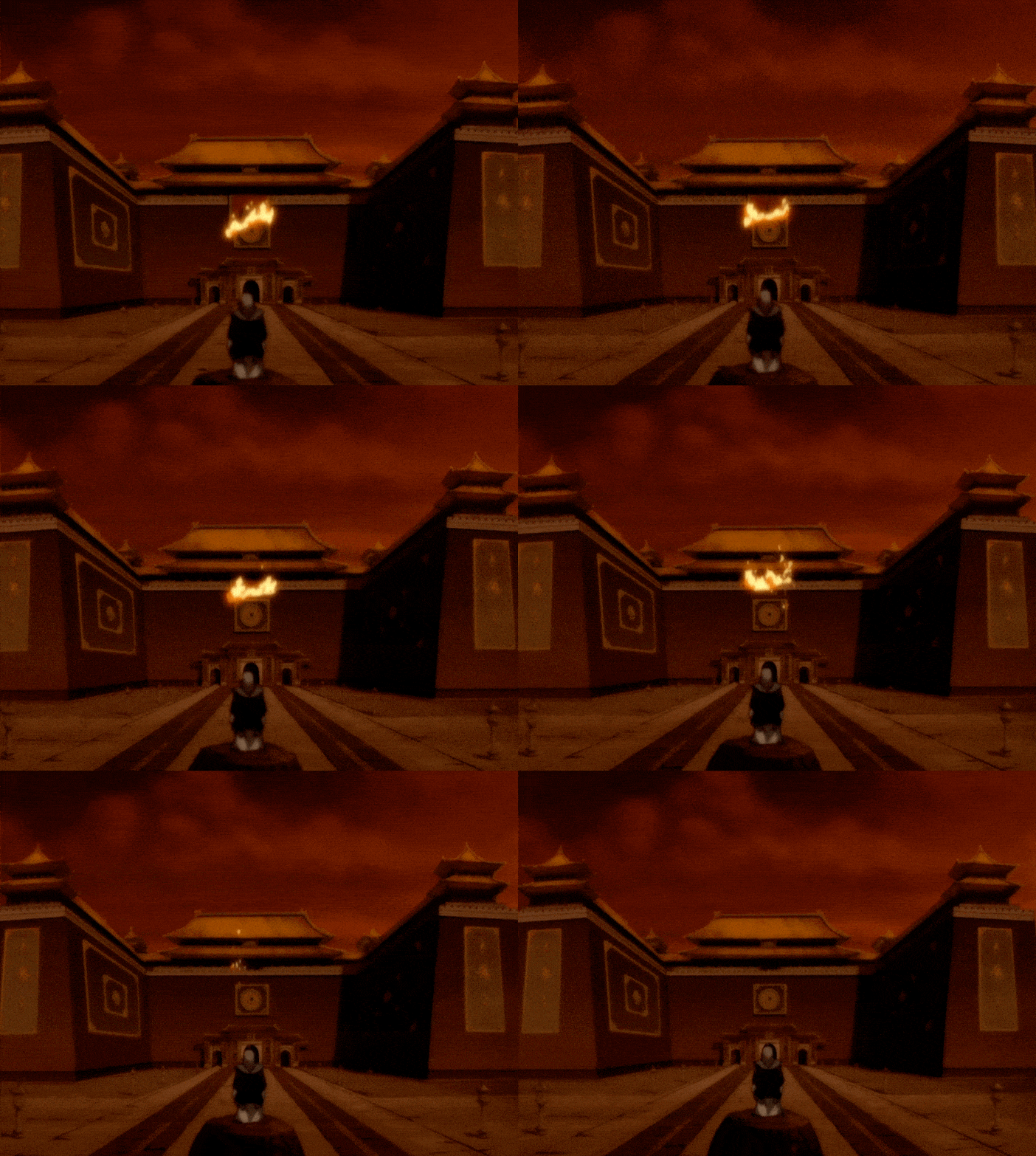
There are quick and wordless moments in “Sozin’s Comet” that hit just as hard as the drawn-out ones. When Iroh burns the Fire Nation flag at the gates of Ba Sing Se to reveal the Earth Kingdom insignia beneath it, it’s a quick moment, but one that captures the bittersweet crux of the series: that while war is endlessly corrosive, peace has the potential to be infinitely restorative.
This message is made even more explicit by a blink-and-you’ll-miss-it moment near the finale’s end. In it, Earthbender children giggle and play around a stack of abandoned Fire Nation military vehicles. From a distance, you can’t see if they wear the colors of any nation — the child who runs by is cloaked in gray and white. While post-series comic books explore the complicated practical details of decolonization, this image is one of pure idealism. It offers the idea of a world in which kids can grow up free from the traumas that Katara, Sokka, Aang, Zuko, and even Azula faced. Thanks to our band of heroes, kids won’t have to save the world–they’ll just get to play.


